


Originally written by Monojit Dutta, updated by Dibyajyoti Kabi. First published July 5, 2017. Updated October 24, 2026.
To flash stock Samsung firmware with Odin, download the firmware for your exact model and region, put the phone in Download mode, load the BL, AP, CP and CSC files in Odin3 on a Windows PC, and click Start. When Odin shows PASS, the phone reboots into clean stock software.
I’ll show you how to pick the right firmware, which CSC file to use so you don’t lose your data by accident, and what to do if the phone gets stuck after the flash.
Key points
- Odin only works on Windows. You also need the Samsung USB driver and a good USB cable.
- The firmware has to match your model number exactly, like SM-S938B or SM-A566E. Firmware for another model can brick the phone.
- Load CSC to wipe the phone, or HOME_CSC to keep your apps and data.
- You can’t downgrade to firmware with an older bootloader version than the one on your phone.
- Official Samsung firmware doesn’t trip Knox, so your warranty and Samsung Wallet keep working.
- One UI 8.5 removed most of the stock recovery menu, and there are reports that Download mode is locked down on the Galaxy S26 series. More on that below.
When should you flash stock firmware?
Flash stock firmware when your Galaxy phone is stuck in a bootloop, soft bricked, running a custom ROM you want to leave, or you want to install an update by hand before it reaches your phone. For a normal update, Settings > Software update > Download and install is easier and safer.
People also use Odin to downgrade to an older One UI build, or to switch the phone to a different region’s firmware. Both are possible, but each has limits I explain further down.
What do you need before you start?
You need a Windows PC, Odin3, the Samsung USB driver, the firmware for your exact model, and a USB cable that carries data. Charge the phone to at least 50% and back up anything you care about first.
- A Windows 10 or Windows 11 PC. Odin doesn’t run on a Mac.
- Odin3 v3.14.4, or the patched 3.13.1 as a fallback.
- The Samsung USB driver installed on the PC.
- The original Samsung cable if you still have it. Cheap charging-only cables are the number one reason Odin fails.
- A backup. Flashing CSC erases everything, and a failed flash can too. My guide on how to back up your Android phone without root covers the options.
How do I find my model number and CSC?
Open Settings > About phone and look at the model number, like SM-S938B. Then go to Settings > About phone > Software information > Service provider software version. The first three-letter code after the model is your active CSC, like INS for India or XEU for the UK.
You’ll need both when you download firmware. The CSC decides the region, the carrier features and the languages that come with the firmware.
If the phone won’t boot, the model number is printed on the Download mode screen and on the sticker or label in the box.
Where do I download Samsung firmware?
Download the firmware with Bifrost, a free tool that pulls the files straight from Samsung’s update servers. Enter your model number and CSC, and Bifrost fetches the latest firmware for that region.
Avoid random firmware sites that make you wait, sign up or install a “download manager”. Bifrost gets the same files Samsung sends to phones over the air, so you don’t need them.
The download comes as a ZIP file of several gigabytes. Extract it, and you’ll find four or five files that start with BL, AP, CP, CSC and HOME_CSC, all ending in .tar.md5.
Should I use CSC or HOME_CSC?
Use CSC when you want a clean install, when you’re coming back from a custom ROM, or when you’re downgrading. It wipes the phone. Use HOME_CSC when you’re only updating to newer firmware from the same region and you want to keep your apps and data.
| Situation | File to load in the CSC slot |
|---|---|
| Bootloop or soft brick | CSC |
| Coming back from a custom ROM | CSC |
| Downgrading One UI | CSC |
| Changing the region (multi-CSC models) | CSC |
| Updating to newer firmware, same region | HOME_CSC |
If you aren’t sure, back up and use CSC. A clean flash rules out leftover data as the cause of any problem.
How to flash stock Samsung firmware with Odin
Here’s the full process. It takes 10 to 20 minutes, most of it waiting for Odin.
- Install the Samsung USB driver on your PC and restart the PC.
- Extract the firmware ZIP into a folder you can find, like your Desktop.
- Extract Odin, right-click the Odin3 .exe file and choose Run as administrator.
- Turn the phone off completely.
- Hold Volume Up and Volume Down together, and while you hold them, plug the USB cable into the phone. The other end should already be in the PC.
- When the warning screen appears, press Volume Up to enter Download mode.
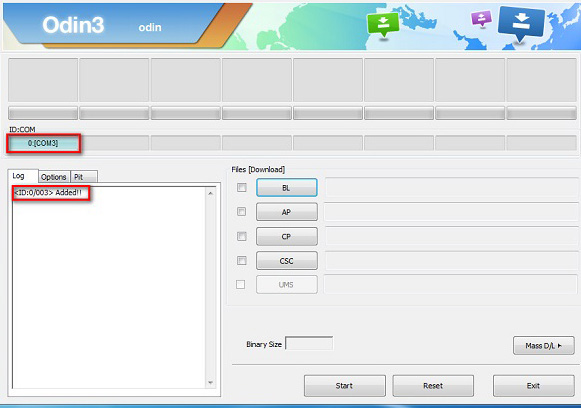
- Look at Odin. A blue box with “COM” and a number should light up in the top left, and the log should say “Added!!”.
- Click BL and choose the file that starts with BL_.
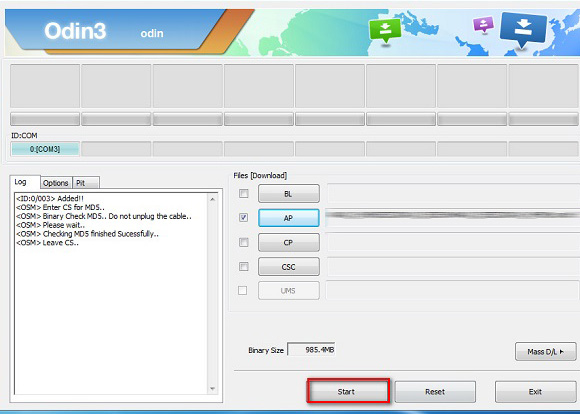
- Click AP and choose the file that starts with AP_. This file is big, so Odin may freeze for a minute while it checks it. Don’t click anything until it responds.
- Click CP and choose the file that starts with CP_. Wi-Fi only tablets don’t have one, so skip it there.
- Click CSC and choose either the CSC_ file or the HOME_CSC_ file, based on the table above.
- Open the Options tab and check that only Auto Reboot and F. Reset Time are ticked. Leave Re-Partition off.
- Click Start and leave the cable alone until it finishes.
- When the box turns green and says PASS, the flash is done. The phone reboots on its own.

The first boot after a full flash can take 5 to 10 minutes. The Samsung logo sitting there for a while is normal, so give it time before you assume something went wrong.
On older Galaxy phones with a Home button, the Download mode combo in step 5 is Volume Down + Home + Power. On the Galaxy S8, S9 and S10, it’s Volume Down + Bixby + Power.
Can I downgrade Samsung firmware with Odin?
Yes, but only to firmware with the same or a newer bootloader version than the one on your phone. If the bootloader version is older, Odin stops with “SW REV CHECK FAIL” and nothing gets flashed. You can’t get around this check with Odin.
The bootloader version is the fifth character from the end of the build number. On a build like S938BXXU5BYJ1, the number is 5. You can flash any firmware with a 5 or higher there, but not one with a 4.
You’ll find your build number in Settings > About phone > Software information.
What if the phone bootloops after flashing?
If the phone keeps restarting after PASS, it’s almost always leftover data from the old software. Boot into recovery and do a factory reset. If you flashed HOME_CSC, flash again with the CSC file instead, which wipes the phone for you.
To get into recovery on a recent Galaxy phone, turn it off, then hold Volume Up and Power until the Samsung logo shows. On a lot of recent firmware the phone has to be plugged into a PC with a USB cable for the combo to work.
In recovery, use the volume keys to pick Wipe data/factory reset and press Power to confirm. Then choose Reboot system now.
What changed with One UI 8.5?
The One UI 8.5 update from February 2026 cut the stock recovery menu down to Reboot system now, Wipe data/factory reset and Power off. Wipe cache partition, Apply update from ADB and Apply update from SD card are gone, as 9to5Google reported.
That doesn’t stop you from flashing firmware with Odin. It does mean that on One UI 8.5, the factory reset in recovery is your only fix for a bootloop without a PC.
There’s more. In March 2026, Android Authority reported a tipster’s claim that Download mode no longer opens on the Galaxy S26 series and the Galaxy Z Fold7 running One UI 8.5. A follow-up from the same tipster said Download mode still works, but only after you turn on Maintenance mode first. Samsung hasn’t confirmed either version, so I’ll update this guide when it does.
If you own one of those phones and the button combo doesn’t open Download mode, update the phone through Settings > Software update or Samsung Smart Switch on a PC instead.
FAQ
Does flashing stock firmware with Odin void the warranty?
No. Official Samsung firmware is signed by Samsung, so it doesn’t trip Knox. Your warranty, Samsung Wallet and Secure Folder keep working. Only unofficial files like TWRP, a custom ROM or a patched boot image trip Knox, and that can’t be undone.
Will flashing firmware remove root and TWRP?
Yes. Flashing the full stock firmware replaces the boot and recovery partitions, so Magisk root and TWRP are both gone afterward. The Knox counter stays tripped if it was tripped before, though.
Why is Odin stuck at SetupConnection?
That’s a driver or cable problem in almost every case. Reinstall the Samsung USB driver, switch to the original cable, use a USB port on the back of the PC and close Smart Switch. My guide on Odin firmware flashing errors covers that one and the others.
Can I flash firmware from another region?
You can if your phone uses multi-CSC firmware and the firmware is for the same model number. Load the CSC file, not HOME_CSC, so the phone picks up the new region on first boot. Don’t flash firmware for a different model number, like SM-S938U firmware on an SM-S938B.
Can I flash only the AP file?
Yes. Flashing only AP updates the system and keeps your data, and some guides use it to fix a single broken partition. For a stuck phone, though, load all the files so the bootloader, modem and system all match.
Related guides
- Download Odin for Samsung (every version)
- How to fix Odin firmware flashing errors
- Download Samsung firmware with Bifrost
- Download the Samsung USB driver
- How to install TWRP on a Samsung Galaxy with Odin
That’s it. Match the firmware to your model, pick CSC or HOME_CSC on purpose, and wait for PASS before you touch the cable.
Got stuck somewhere? Leave a comment with your Galaxy model number (like SM-A566E), the build number you’re flashing and the last line Odin shows, and I’ll help you sort it out.